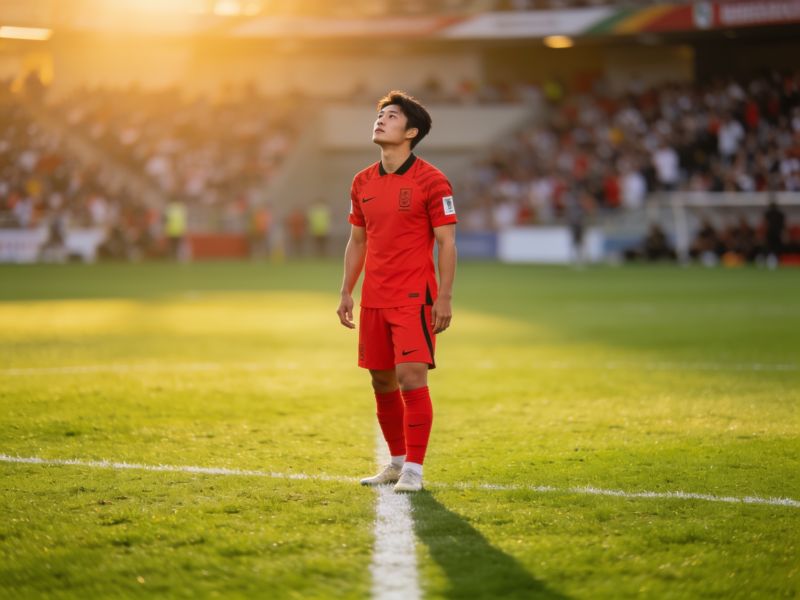
Summary: Kim Dong-jin was never the loudest name on the team sheet, yet his understanding of space and timing
Kim Dong-jin doesn't score many goals. That's not his job. Watch him for ninety minutes and you'll see a player who treats space like currency—always saving it, always spending it at the right moment. In the 2006 World Cup match against Switzerland。with South Korea chasing the game, Kim drifted inside from left-back and played a diagonal ball that split two defenders. It didn't lead to a goal. But it forced the Swiss midfield to shift, and for ten minutes afterward, Korea controlled possession. That's the kind of detail that never makes highlight reels, yet it defined his career.He emerged from the K-League system in the early 2000s。a period when Korean football was still figuring out how to produce technical defenders rather than pure stoppers. Kim had something different: a left foot that could deliver a cross from a standing start, and a habit of stepping into midfield instead of hoofing the ball clear. Coaches sometimes yelled at him for it. Once, during a club match in 2004, he lost the ball near his own box trying to play out. The opposition scored. After the game, he told reporters, "I'd rather make that mistake than kick it into the stands." Not many defenders say that. Most wouldn't even think it.
His move to Zenit St. Petersburg in 2006 raised eyebrows—a Korean full-back in the Russian Premier League?But he adapted faster than expected. The Russian game was physical, direct, and relentless. Kim added steel to his finesse. He learned to use his body in ways that K-League referees would have whistled for. A former teammate once described him as "the quietest loud player"—meaning he didn't shout, but his positioning commanded attention. In 2008, Zenit won the UEFA Cup. Kim played every knockout match. No goals。no assists in the final. But his clearance off the line in the semi-final against Bayern Munich?That's the reason they advanced.International football suited him less obviously. South Korea's setup often asked full-backs to bomb forward constantly, leaving gaps. Kim preferred a more measured approach—overlap when it's on, sit when it's not. Some fans called it conservative. He called it reading the game. "If I go forward every time, the winger knows exactly where I'll be。" he said in a 2009 interview. "Sometimes I stay. Then the winger has to think." That tactical patience frustrated managers who wanted chaos. But against stronger opponents, it kept Korea compact. His 2010 World Cup performance against Greece—a 2-0 win—was a masterclass in silent control. He never sprinted more than twenty meters without looking over his shoulder.
Kim retired from international football in 2011, then played a few more seasons in Korea before fading from the spotlight. No farewell tour, no testimonial. He now runs a youth academy outside Seoul, focusing on what he calls "decision-making under pressure"—small-sided games where defenders are encouraged to dribble out of trouble. Some of his former coaches would hate that. Kim doesn't care. "The game changed。" he told a local newspaper last year. "We can't keep producing robots who only clear the ball." You won't find him on lists of Korean football legends. But watch any modern full-back who plays with a little patience, a little deception, and you're seeing a piece of Kim Dong-jin's legacy. Quiet. Effective. Gone before you notice.