Summary: Explore the quiet legacy of Antonini, a small Brianza workshop whose mid-century furniture and brass
Walk into a mid-century Milanese apartment。and you might spot a slender brass floor lamp with a dome shade, its base weighted by a single slab of walnut. That lamp, often attributed to 'the Antonini workshop,' isn't just a piece of furniture. It's a clue to a broader story about how Italian design absorbed and transformed industrial materials in the 1950s and 60s. Antonini—a name rarely shouted in design history surveys—nevertheless left fingerprints on lighting, furniture, and the way we think about restrained elegance. I first encountered an Antonini piece at a flea market in Turin;the dealer shrugged and said, 'It's just Antonini,' as if that explained everything. It didn't, but it made me look closer.
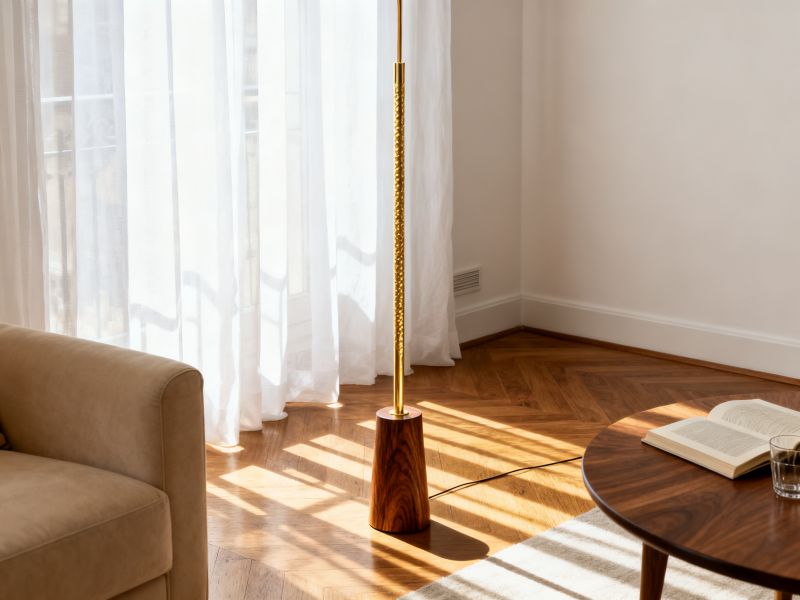
The Antonini family's output spanned three decades, from the late 1940s into the 1970s, and it remained deliberately small-scale. Their workshop in Brianza, north of Milan, produced maybe a few hundred pieces a year—no mass-market catalog。no splashy ads. What set Antonini apart was a stubborn commitment to joinery. Look at their side tables: the legs taper with almost obsessive precision, and the brass fittings are hand-turned, not stamped. In an era when Italian design was racing toward plastic and molded plywood, Antonini kept working in solid ash and cast metal. That wasn't nostalgia;it was a bet that certain buyers would pay for tactile quality over trend. My own view: Antonini's resistance to the plastic wave made their work feel old-fashioned by 1965, but today it reads as prescient.Take the 'Tesa' shelving unit from 1958—a modular system with vertical uprights and adjustable shelves, all in blackened steel and teak. It never won a Compasso d'Oro, and it wasn't featured in Domus. But flip through auction catalogs from the last five years, and 'Tesa' units routinely sell for three to four times their estimate. Why?Because the proportions are right: the uprights are 2.5 centimeters wide, no more, and the shelves sit on discreet brass pins. There's no decoration, no flourish—just a calm grid that holds books and ceramics without shouting. I've seen one in a friend's apartment in Rome, loaded with mismatched paperbacks and a single ceramic bowl. It looked inevitable。like it had always been there. That's harder to design than it sounds.Antonini's lighting tells a similar story. The 'Nastro' floor lamp (1962) uses a bent brass arm and a fabric shade that clips on with a simple friction fit. No screws, no visible wiring. The shade tilts with a gentle push, and the whole thing weighs under four kilograms. A collector in Brussels told me she owns three 'Nastro' lamps and has never had to repair one. 'The switch is the only thing that wears out,' she said. That kind of durability is rare in mid-century lighting, where brittle plastic sockets and thin wiring are common. Antonini's choice of heavy-gauge brass for the arm wasn't cheap。
but it meant the lamp could take a knock. You don't see that level of material honesty often anymore.So why does Antonini remain a footnote?Partly because the family never sought publicity—no archives, no foundation, no retrospective at the Triennale. The workshop closed in 1978 when the second generation moved into industrial tooling. Pieces surface at auction with vague provenance: 'Italian。1960s, attributed to Antonini.' That ambiguity frustrates scholars but adds a kind of mystique for collectors. I'd argue that Antonini's obscurity is exactly why their work still feels fresh. Without a legend to prop up, the objects have to speak for themselves. And they do—quietly, in walnut and brass, one careful joint at a time.